So you’ve got a tooth that’s bugging you. Maybe it’s chipped, maybe it’s stained, maybe it’s just a funny shape. And somewhere along the way you’ve heard two words thrown around: veneer and crown.
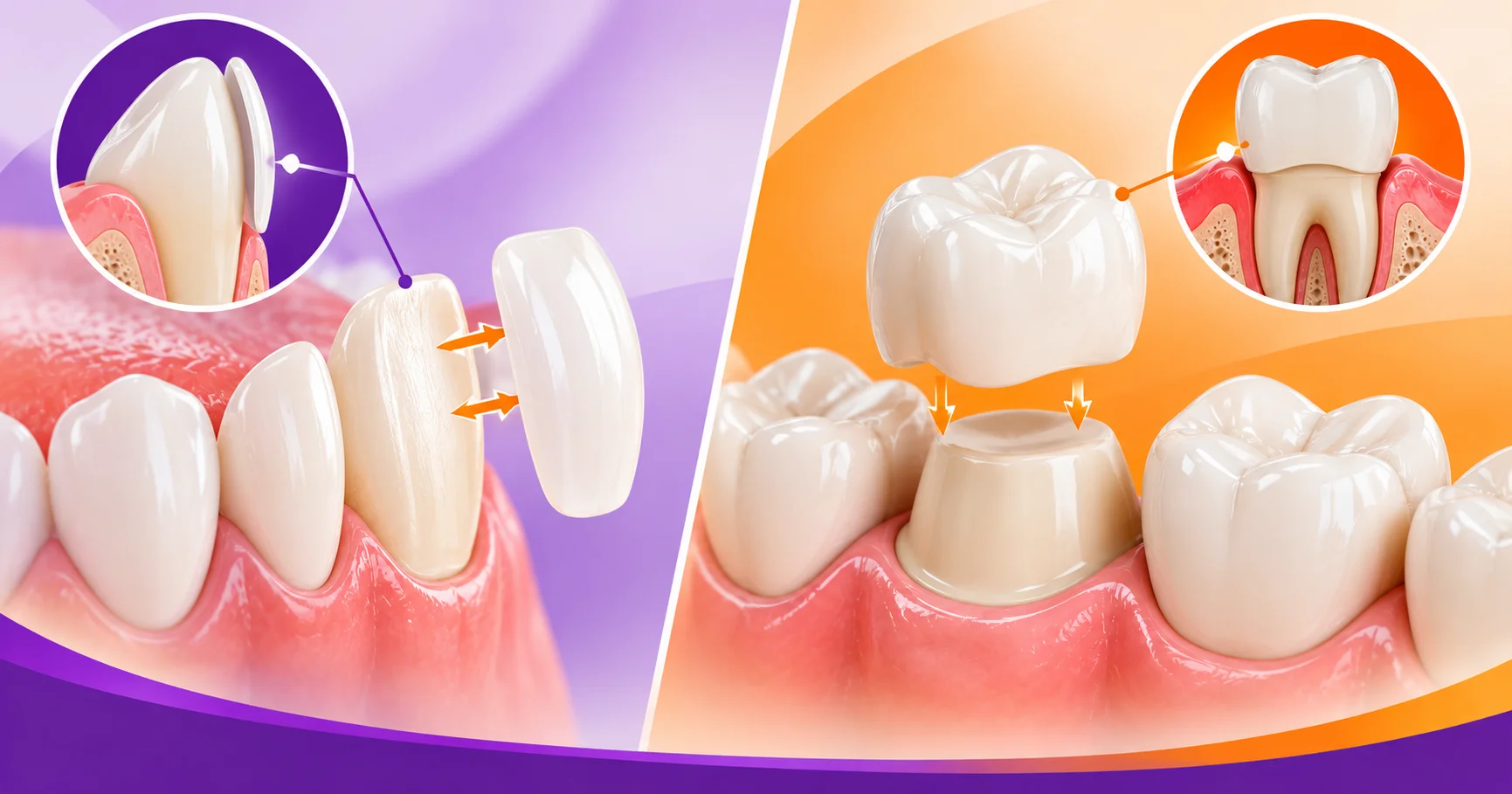
Here’s the short version of veneers vs crowns. A veneer covers the front surface of a tooth. A crown covers the whole tooth, all the way round. That’s the big one. Most of the other differences come back to it.
What does a veneer cover?
Picture a false front for your tooth, a bit like a fingernail. That’s a veneer. It’s a thin shell of porcelain or composite resin, stuck onto the part people see when you smile.
The Australian Dental Association lists the usual reasons people get one: gaps, stains, chips, and teeth that are a little crooked or a funny shape. Pretty much the cosmetic stuff.
And how much tooth do you lose? Less than most people expect. Often it’s a thin sliver of enamel, sometimes nothing at all. Just enough so the veneer doesn’t look bulky next to its neighbours. (Here’s how we do porcelain veneers.)
What does a crown cover?
A crown is the bigger job. It slips over the whole visible tooth like a cap, so your dentist has to shave the tooth down on every side first to make room.
Your dentist can make one from porcelain, zirconia, gold alloy, or porcelain fused to metal. The ADA lists crowns for teeth that are badly broken, cracked or decayed. You’ll also see them after root canal treatment (our root canal treatment guide explains why). Here’s how we fit dental crowns.
What is the difference between veneers and crowns?
The main difference between veneers and crowns is how much of the tooth they cover. A veneer sits on the front only, so your dentist removes little or no enamel. A crown covers the whole tooth after your dentist trims it back, so dentists tend to use crowns when a tooth is cracked, broken or root-filled.
| Veneer | Crown | |
|---|---|---|
| What it covers | The front surface only | The whole visible tooth |
| Natural tooth removed | A small amount of enamel from the front, sometimes none | More: the tooth is trimmed back on all sides |
| Best for (rule of thumb) | Stains, chips, small gaps or an uneven shape on a healthy tooth | Cracked, broken, heavily filled or root-filled teeth |
| Typical lifespan (research) | 95.5% of porcelain veneers still in place at 10 years (Alenezi et al., 2021) | 94.7% of metal-ceramic crowns still in place at 5 years (Sailer et al., 2015) |
| Care | Brush twice a day, clean between teeth daily, regular check-ups | The same as veneers |
| Reversibility | Not reversible. You can’t take veneers off. | Not reversible. The trimmed tooth needs covering from then on. |
Quick heads-up on the table: the “best for” row is a rule of thumb, not a diagnosis. And the two studies measured different time spans, so they don’t tell you which one lasts longer.
When is a veneer the better fit?
Veneers are at their best when the tooth itself is fine (strong, healthy, no big fillings) but you just don’t love how it looks. Things like:
- staining that whitening hasn’t shifted
- a small chip on the edge of a front tooth
- small gaps between teeth
- a tooth that’s always looked a bit short, or a funny shape
Here’s one people miss: colour. Once a veneer’s on, you can’t whiten it (healthdirect says so too). So do any whitening first. Our article on whether Zoom whitening is safe for enamel is a good place to start.
Teeth only a little crooked? It might be worth asking about Invisalign or braces instead. They straighten the teeth you’ve got, rather than covering them up.
When is a crown the better fit?
Crowns come into their own when a tooth needs holding together, not just tidying up. Your dentist may suggest one for:
- a cracked tooth
- a tooth with a large old filling and little natural tooth left
- a tooth that has had root canal treatment
- a broken or badly chipped tooth, where there’s not enough left for a veneer to stick to
The downside? You lose more of your own tooth to fit it.
Still not sure which camp you’re in? That’s fine. That’s our job to work out, not yours. Pop in, and we’ll have a look, take X-rays if we need them and talk you through both. Book a consultation.
Crown or veneer for a front tooth: which suits it?
Both can work on a front tooth. Some guides say crowns are only for back teeth. Not quite. It’s the state of the tooth that decides, not where it sits.
Got a front tooth with good enamel and a purely cosmetic problem? A veneer’s often the gentler option, because more of your own tooth stays put. Broken, badly cracked or had a root canal? Then a crown may make more sense, because that tooth needs the extra support. There’s more on the cosmetic side in our guide to veneers for your front teeth.
Porcelain veneers vs crowns: how long do they last?
Here’s the honest answer: nobody can promise you a number. How long a veneer or crown lasts comes down to your bite, whether you grind, what you eat and how well you look after it. That said, the research is a useful guide.
- Porcelain veneers. A 2021 review of clinical studies in the Journal of Clinical Medicine estimated that 95.5% of porcelain veneers were still in place after 10 years.
- Crowns. A 2015 review in Dental Materials found that 94.7% of metal-ceramic single crowns were still going after 5 years.
Don’t line those two numbers up against each other, though. The studies measured different time frames, so they can’t tell you which lasts longer. Both the ADA and healthdirect also note that veneers and crowns can chip, crack or discolour over time. Assume you may need a replacement at some stage, and budget for it.
What does a dentist check before recommending a veneer or a crown?
Before anyone talks porcelain or zirconia, your dentist has to see what they’re working with. That means a proper look at the tooth and at how your whole bite comes together.

What your dentist looks at
- Enamel. Veneers stick to the front of the tooth. Not much sound enamel there? Then there’s not much for a veneer to hold on to.
- Old fillings and cracks. A big filling, a crack or a missing corner can leave a veneer with too little to grip.
- Root canal history. The ADA puts root-filled teeth on the list of teeth that may need a crown.
- Gums and decay. Your dentist sorts out decay or any signs of gum disease first. The cosmetic stuff can wait.
- Your bite. Do you clench or grind, especially at night? That’s extra force your new veneer or crown has to put up with.
- X-rays and shade. X-rays show what’s happening inside the tooth and down at the root. A shade check means the new tooth won’t stick out like a sore thumb.
What to ask before you say yes
In 2023, the Dental Board of Australia said veneers “can be major life-long undertakings that are not risk free.” Fair enough, too. Its advice is to be clear on why you want the work, what the health and money risks are, and what your other options look like. Take your time. Get a second opinion if something doesn’t sit right.
Bring a few questions with you. Why this option and not the other one? What happens if it chips? What’s it going to cost to replace down the track?
Quick decision guide
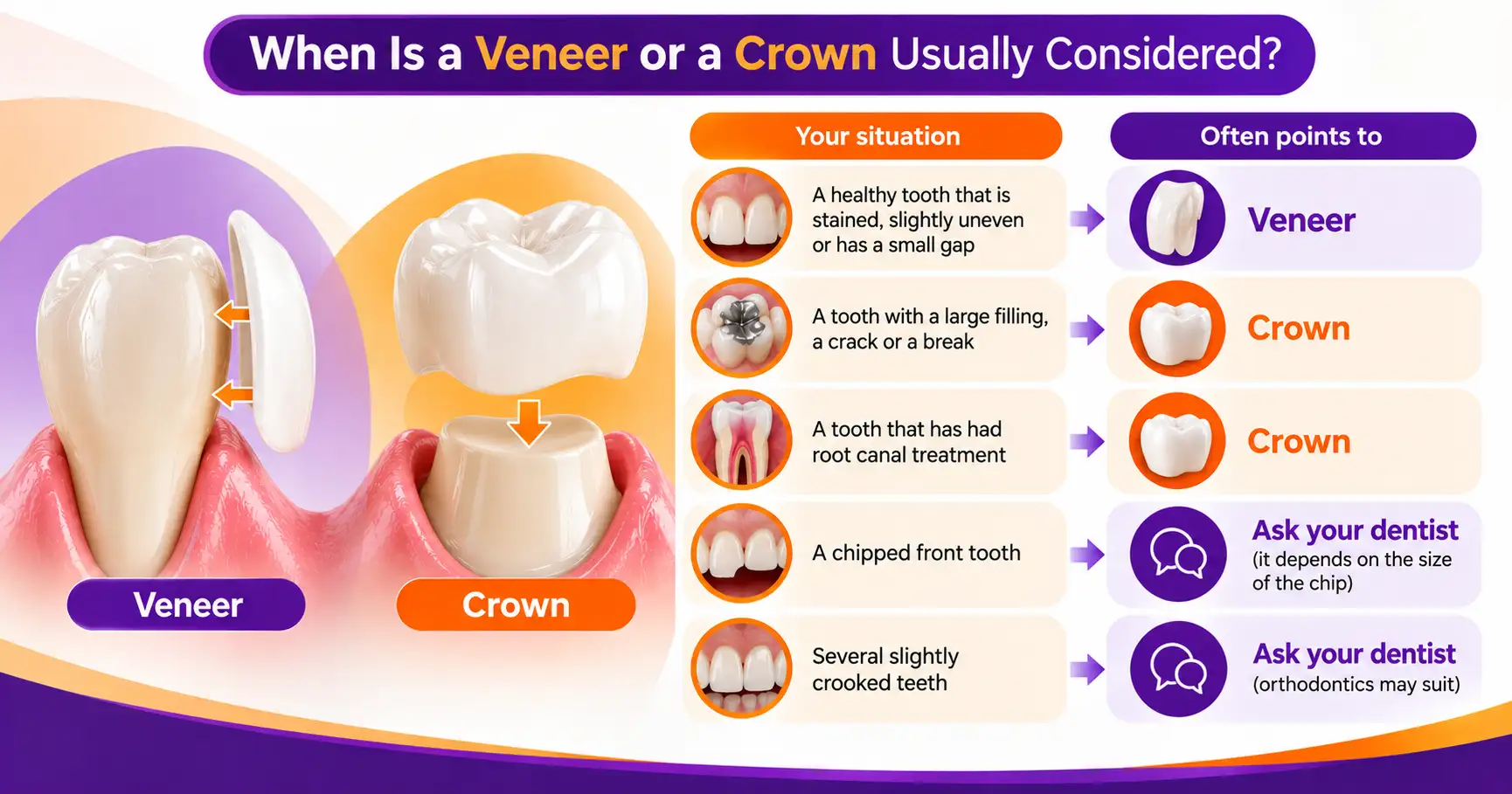
Treat this as a rough guide, not a diagnosis. Your dentist will confirm the right option once they’ve examined the tooth.
| Your situation | Often points to |
|---|---|
| A healthy tooth that is stained, slightly uneven or has a small gap | Veneer |
| A tooth with a large filling, a crack or a break | Crown |
| A tooth that has had root canal treatment | Crown |
| A chipped front tooth | Ask your dentist (it depends on the size of the chip) |
| Several slightly crooked teeth | Ask your dentist (orthodontics may suit) |
Frequently asked questions
Do veneers or crowns remove more tooth?
Crowns remove more. Your dentist trims the tooth back on all sides so the crown can fit over it. With a veneer it’s usually a thin layer off the front, and sometimes nothing, according to the Australian Dental Association. Whatever comes off doesn’t grow back, though, so take your time deciding.
Can I get a veneer instead of a crown?
Sometimes. It really depends on how much of the tooth is left. A strong tooth that just needs a cosmetic fix might suit a veneer. A cracked, heavily filled or root-filled tooth usually needs the extra strength of a crown. Your dentist will tell you which after checking the tooth, your bite and your X-rays.
Are veneers cheaper than crowns?
Not always. Anyone giving you a flat answer online hasn’t seen your teeth. The price depends on the material, how many teeth you’re doing and how much work each one needs. healthdirect says porcelain veneers usually cost more than composite ones. Ask for a written, itemised quote first, and remember replacements cost money too.
Do veneers ruin your teeth?
“Ruin” is a strong word. But veneers are permanent, and any enamel your dentist trims off is gone for good. healthdirect lists risks like sensitivity, cracking and edges that show if your gums recede. The Dental Board of Australia calls veneers a major life-long undertaking, so ask about the risks and the alternatives before you commit.
Not sure which one your tooth needs?
The only way to know for sure is to have someone look at it. At Kings Langleys Dental Surgery, our dentists will check the tooth, explain both options in plain English and talk through costs before anything starts. Book a consultation and bring your questions. No question’s too small.