
Your dental extras probably reset on 1 January. Anything you haven’t claimed by 31 December is gone, and your fund keeps it. With about seven weeks left in 2026, now is the time to use your dental extras before the end of the year, while December appointments are still open.
Most people leave money on the table. A Canstar survey of 1,961 Australians found 85% don’t use their full extras limits each year, and 44% don’t know the limit for each service. The easiest fix is the simplest claim there is: a check-up and clean.
Do Dental Extras Reset on 1 January?
For most people, yes. About 90% of the health funds Canstar tracks reset extras limits on 1 January, including Bupa, Medibank, HCF and nib. A few, such as ahm, reset on 1 July, and some reset on the date you joined. You lose any limit you don’t claim before the reset.
Your policy brochure or member app tells you which applies. Look for “calendar year”, “financial year” or “membership year” next to your dental limits.
Check even if you think you know. Families who changed funds mid-year, or hold two policies, often find the dates don’t match.
What Happens to Unused Extras?
Usually, they expire. Unused dental benefits don’t come back as a refund and don’t lower next year’s premium. Rollover exists but it’s rare. CHOICE names Police Health and
Emergency Services Health as two of the very few funds that let you claim some unused benefits the following year. ahm also rolled over most unused 2025/26 limits on some covers, but says it decides that year by year.
Limits also sit in separate buckets. Most policies have one limit for general dental and another for major dental. Orthodontics often has a lifetime limit that never resets. So $500 of untouched general dental can’t move across to pay for a crown next year.
You pay the premium either way. The only question is whether you claim what it buys.
What Dental Treatments Do Extras Usually Cover?
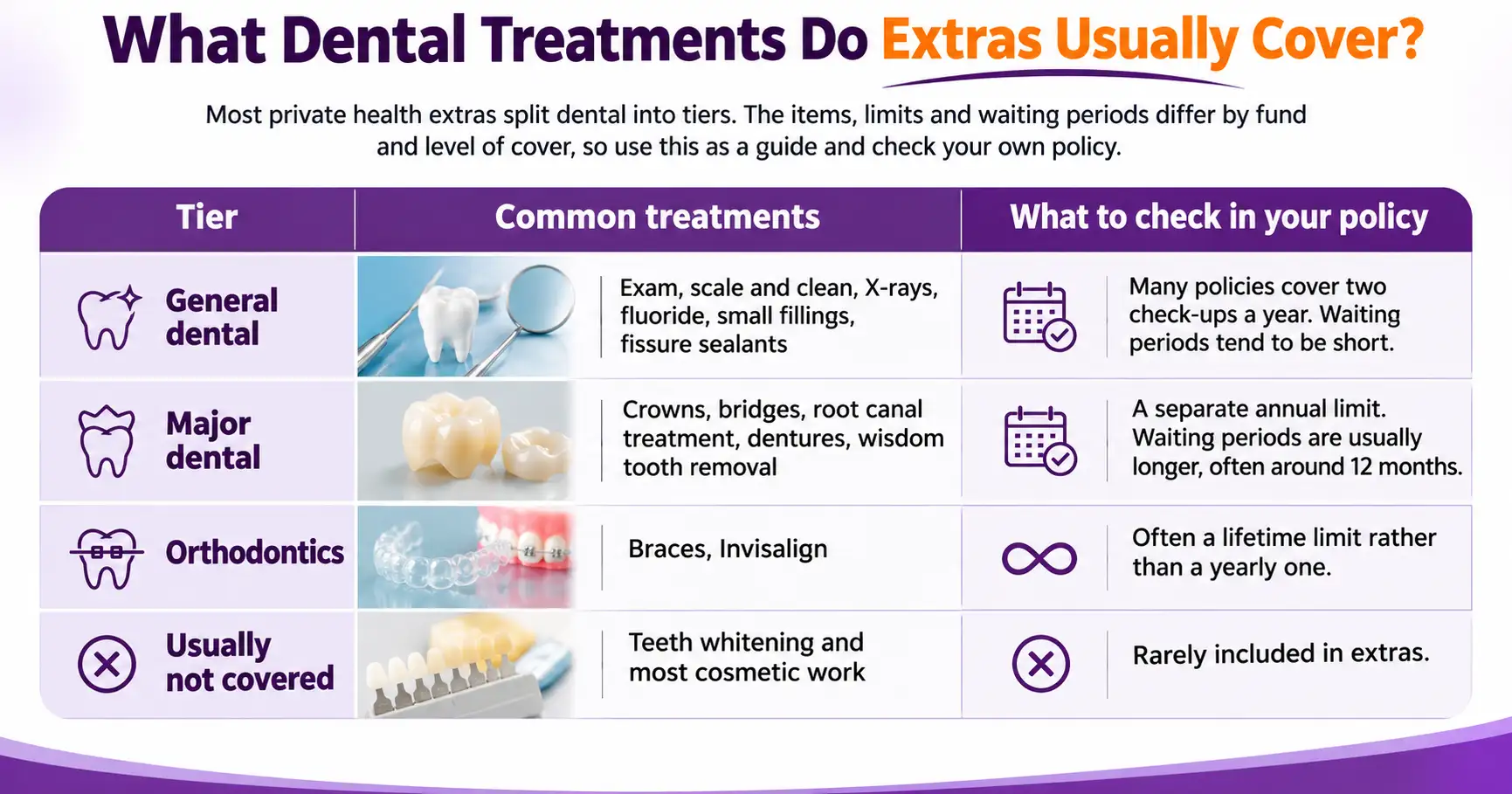
Most private health extras split dental into tiers. The items, limits and waiting periods differ by fund and level of cover, so use this as a guide and check your own policy.
| Tier | Common Treatments | What to Check in Your Policy |
|---|---|---|
| General dental | Exam, scale and clean, X-rays, fluoride, small fillings, fissure sealants | Many policies cover two check-ups a year. Waiting periods tend to be short. |
| Major dental | Crowns, bridges, root canal treatment, dentures, wisdom tooth removal | A separate annual limit. Waiting periods are usually longer, often around 12 months. |
| Orthodontics | Braces, Invisalign | Often a lifetime limit rather than a yearly one. |
| Usually not covered | Teeth whitening and most cosmetic work | Rarely included in extras. |
An extras cover dental check-up is the simplest claim to fit in before Christmas. It takes one visit, and on many policies it leaves little to pay. It also catches small problems early, while a cavity still needs only a small filling. Our page on regular check-ups and cleans explains what happens at the visit, and our guide to tooth decay shows why timing matters.
One honest caution. Canstar found one in three people pay for treatment they don’t need, just to use their cover before it resets. Don’t. Claim what your mouth actually needs, and leave the rest.
How Can You Use Dental Extras Before End of Year?
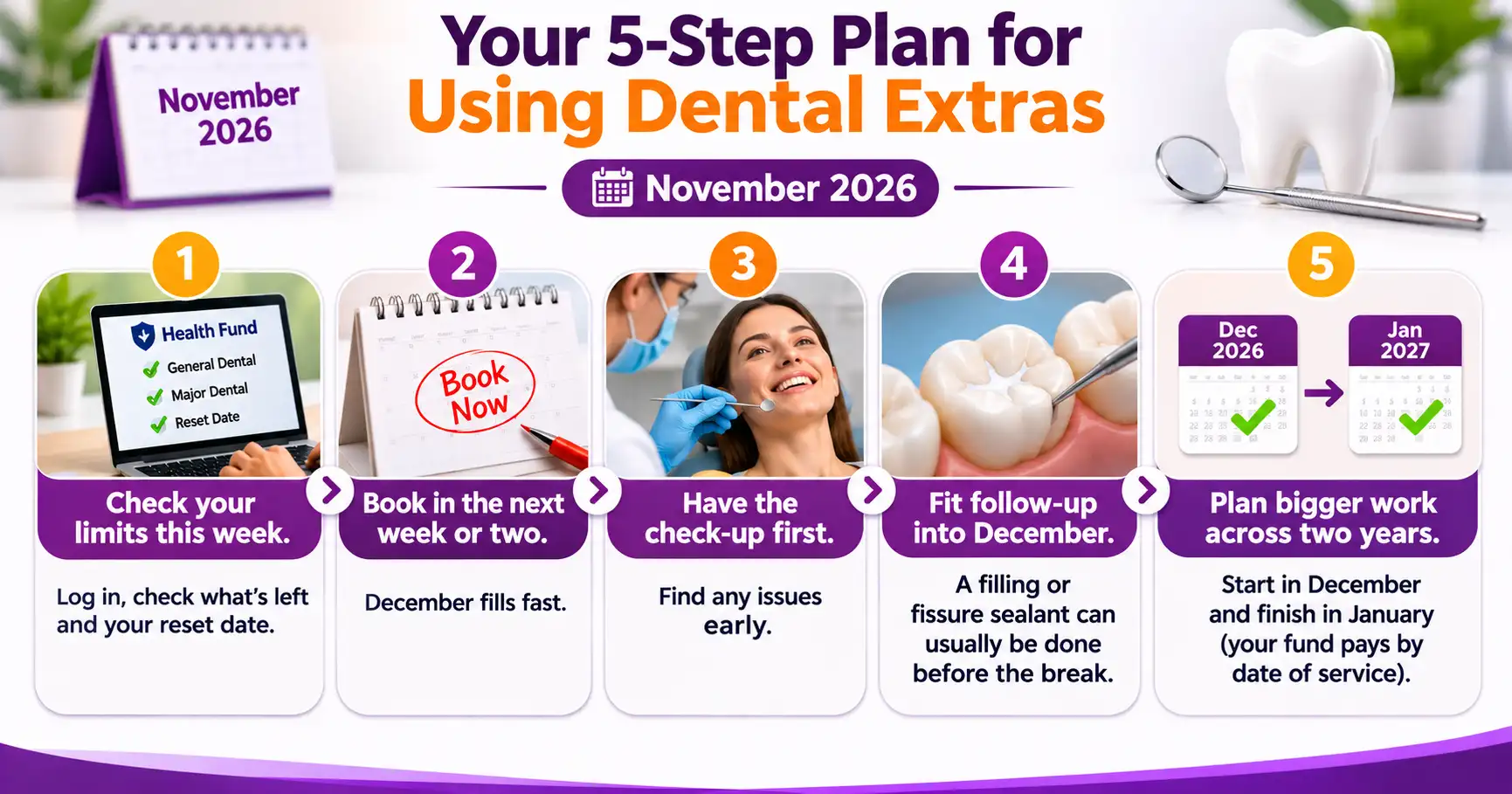
Seven weeks sounds like plenty. It isn’t, once you factor in school holidays, work parties and everyone else with the same idea. Here’s a simple order to work in.
- Check your limits this week. Log in to your fund’s app. Note what’s left in general dental and major dental, plus your reset date.
- Book in the next week or two. December fills fast, and the last fortnight before the Christmas break goes first.
- Have the check-up first. The exam tells you whether anything else needs doing, while there’s still time this year.
- Fit any follow-up into December. A filling or fissure sealants found at your check-up can usually go in before the break.
- Plan bigger work across two years. Treatment with several stages, such as root canal treatment or a crown, can start in December and finish in January. Funds pay by date of service, so part of the cost may fall on next year’s limit. Ask us which item numbers fall on which date, then ask your fund how it pays them.
Worth doing in that order. Step five alone can stretch two years of major dental limits across one treatment.
Ready to book? Call (02) 9674 1964 or request an appointment online.
Can I Claim on the Spot With HICAPS?
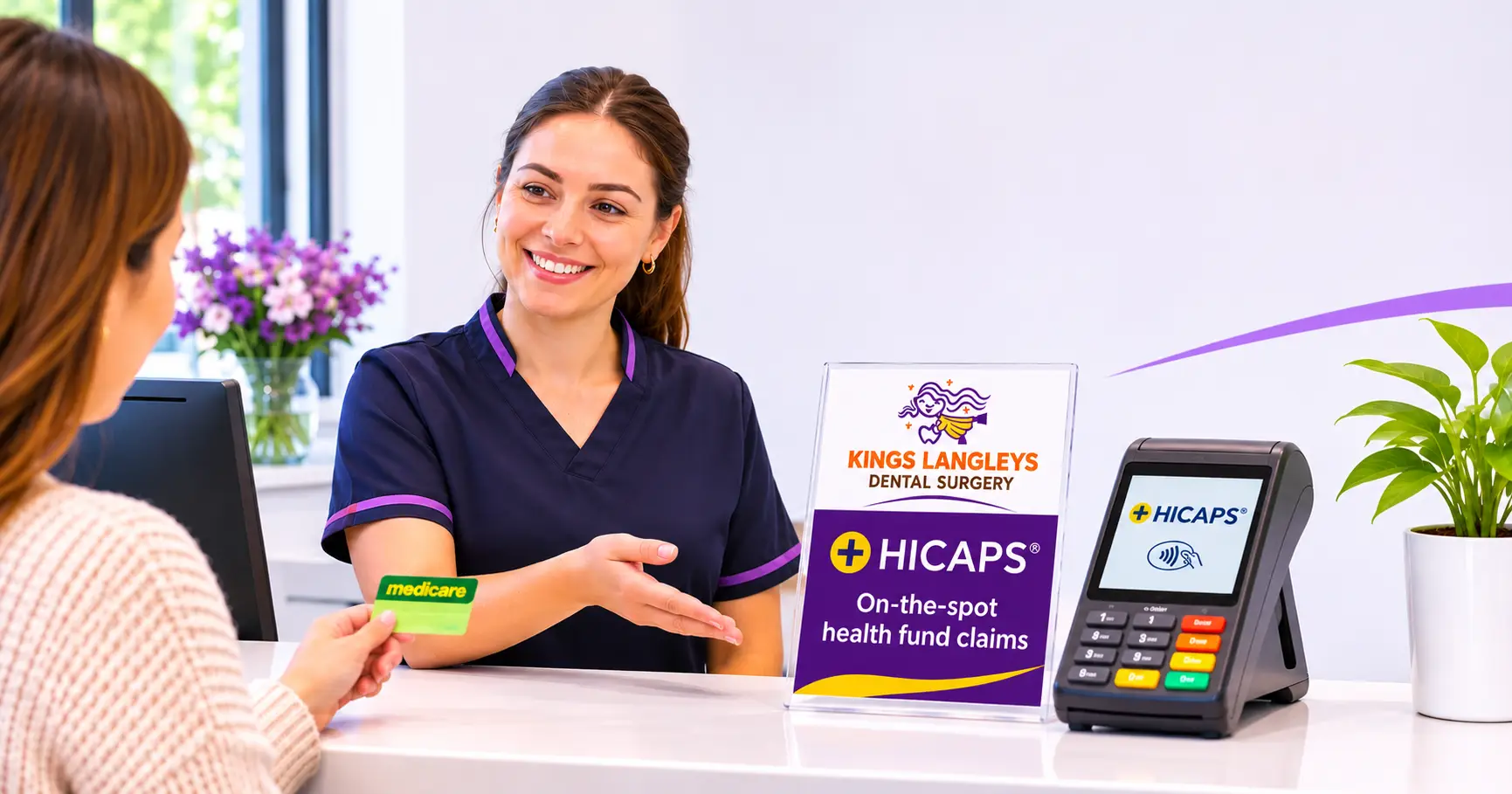
Yes. HICAPS is the terminal at the front desk that sends your claim to your fund while you’re still at the practice. Your fund card goes through, the fund’s share comes off the bill straight away, and you pay only the gap. No claim forms and no waiting for a refund.
HICAPS partners with every Australian private health insurer, so your fund doesn’t change how you claim. Your level of cover decides how much comes back.
Want to know the gap before you commit? Ask us for the item numbers after your exam. Your fund can quote what it will pay for each one.
Is CDBS Affected by the End of the Year?
Not the way extras are. The Child Dental Benefits Schedule (CDBS) is a Medicare program, not private health cover. It gives eligible children up to $1,158 for basic dental services over two consecutive calendar years. Any amount your child doesn’t use in the first year carries into the second, as long as they’re still eligible, so 1 January doesn’t wipe it.
The catch: the balance ends with the two-year period, and you can’t use leftover funds after that. A child whose current period started in 2025 has until 31 December 2026 to use what’s left, on the earlier $1,132 cap. For those families, this year’s deadline applies after all.
Not sure which year your child’s period started? Ask at your child’s next visit, or read our CDBS page for what the scheme covers.
Book Before the December Rush
Kings Langleys Dental Surgery has cared for families across Kings Langley, Blacktown and the Hills District for more than 46 years. You can claim on the spot with HICAPS at our Kings Langley surgery on Solander Road, with free off-street parking right at the door.
Call (02) 9674 1964 or book online. Need treatment beyond your extras limit? See our payment options, including interest-free Smile Right payment plans.
Frequently Asked Questions
Do unused dental extras roll over to next year?
Usually not. Most Australian health funds reset unused extras limits to zero. CHOICE names Police Health and Emergency Services Health as rare exceptions for some services, and ahm rolled over most unused 2025/26 limits on some covers. Assume you lose yours unless your policy says otherwise.
How do I check how many extras I have left?
Log in to your health fund’s app or member website, where most funds show the remaining limit for each service. You can also call your fund. Ask for both general dental and major dental, because they are separate limits, and check the date they reset.
Does a late December appointment still count this year?
Yes. Funds assess dental claims by the date of service, so a check-up on 30 December uses this year’s limit. The catch is availability. Late December books out first, and many practices close over Christmas, so book now rather than counting on the last week.
My fund resets on 1 July. Does this still apply?
The same plan works, with a different deadline. ahm and a small number of other funds reset extras on 1 July, so limits normally expire on 30 June. Some funds reset on the anniversary of the date you joined. Your policy brochure states which one you have.
Is it worth booking a check-up only to use my extras?
For most people, yes. You’ve already paid for the cover through your premium, and a check-up and clean is the claim most policies support. It also finds small problems early, when treatment is quicker and cheaper. Skip treatment you don’t actually need, though.
Do family policies share one dental limit?
It depends on the policy. Some family extras limits apply per person, while others pool across everyone on the policy. Check your brochure before booking the whole family, so one person’s crown doesn’t use up the limit you planned for the kids’ check-ups.
Can I still claim if I forgot to claim on the day?
Often, yes. Many funds accept claims up to two years after the date of service, as long as you hadn’t hit that year’s limit. The claim still counts against the year you had the treatment. Claiming on the spot with HICAPS saves you the paperwork.