Day two is usually the worst of it. By the end of the week, most people are back on pasta and wondering what the fuss was about. Wisdom teeth removal recovery follows a fairly predictable pattern, and once you know it, the rough days feel a lot less worrying. You’ll know whether that ache on day four is normal, or a reason to ring us.
Haven’t had yours out yet? This guide is for after surgery. For the before part, our post on the signs you might need wisdom teeth removal is the better read.
How Long Does Wisdom Teeth Recovery Take?
Most people recover from wisdom teeth removal in about a week. After a surgical removal, swelling can peak about 36 to 48 hours in and starts to go down after 4 to 5 days. Expect to be back at work or study within 1 to 7 days, depending on how difficult the removal was. The gum itself takes a few weeks to close over.
That lines up with Healthdirect, the government’s health advice service, which says to allow up to a week off work and to expect normal activities within a week.
So why such a wide range? Mostly it comes down to the tooth. An upper wisdom tooth that’s already through the gum often comes out with very little fuss, and some people feel fine the next day. A lower one stuck under gum or bone (an impacted tooth) is a different job. It usually means a small cut in the gum, maybe a couple of stitches, and a full week of taking it easy. All four out at once? Both sides of your mouth will be sore together, so the first few days run slower.
Wisdom Teeth Removal Recovery Day by Day
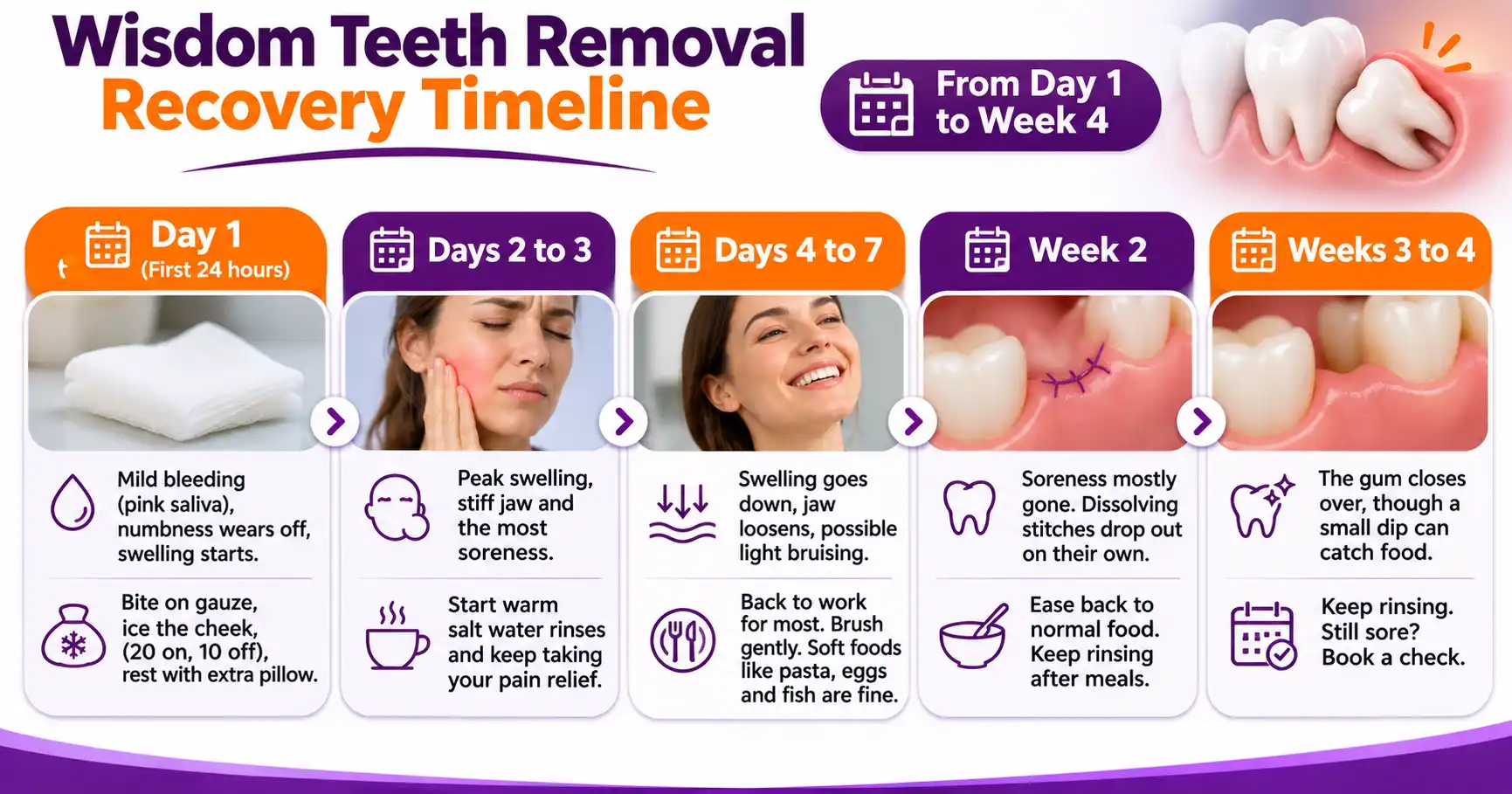
Everyone heals a little differently, and the instructions we give you on the day come first. But this is roughly how the week goes, based on SA Dental’s aftercare guidance and what we see in the chair.
| When | What You’ll Probably Notice | What Helps |
|---|---|---|
| First 24 hours | A small ooze of blood (pink saliva is normal), numbness wearing off over a few hours, swelling just starting. | Bite on the gauze. Sleep with an extra pillow. Use an ice pack on the cheek for 20 minutes on and 10 minutes off. Leave the socket alone: no rinsing, spitting or straws. |
| Days 2 to 3 | The peak. Puffy cheek, stiff jaw and the most soreness of the week. | Start warm salt water rinses after meals and before bed. Keep taking the pain relief your dentist recommended. |
| Days 4 to 7 | Swelling going down, jaw loosening up and maybe some yellowish bruising as it fades. | Most people are back at work by now. Brush gently near the site. Pasta, eggs and fish are fine. |
| Week 2 | Soreness mostly gone. Dissolving stitches drop out on their own. | Ease back towards normal food. Keep rinsing after meals. |
| Weeks 3 to 4 | The gum closes over, though a small dip can catch food for a while. | Keep rinsing. Still sore? Book a check-up. |
For pain relief, SA Dental suggests paracetamol and/or ibuprofen. Skip ibuprofen and aspirin if you’re allergic to them or have asthma, reflux or stomach ulcers, and follow your dentist’s advice on doses.
How Long Does Wisdom Teeth Removal Swelling Last?
Wisdom teeth removal swelling creeps up over the first day. After a surgical removal, SA Dental says it can peak about 36 to 48 hours in, then starts to go down after 4 to 5 days. Some people look like a chipmunk for a day or two. Others barely swell at all. Bruising sometimes shows up as the swelling fades. That’s normal too.
Watch the direction, not the size. Swelling that’s still getting bigger after day 3 isn’t following the usual pattern, so give us a call.
You’ll probably notice a stiff jaw as well. Dentists call it trismus. The muscles near the surgery site tighten up along with the swelling, and SA Dental notes it gets easier as the swelling goes down.
Is Wisdom Teeth Removal Pain After 3 Days Normal?
Some of it is, yes. What matters is which way it’s heading. Day 3 should feel about the same as day 2, or a bit better. Wisdom teeth removal pain after 3 days that’s getting worse, especially a throbbing that creeps up towards your ear, is the classic sign of dry socket or infection.
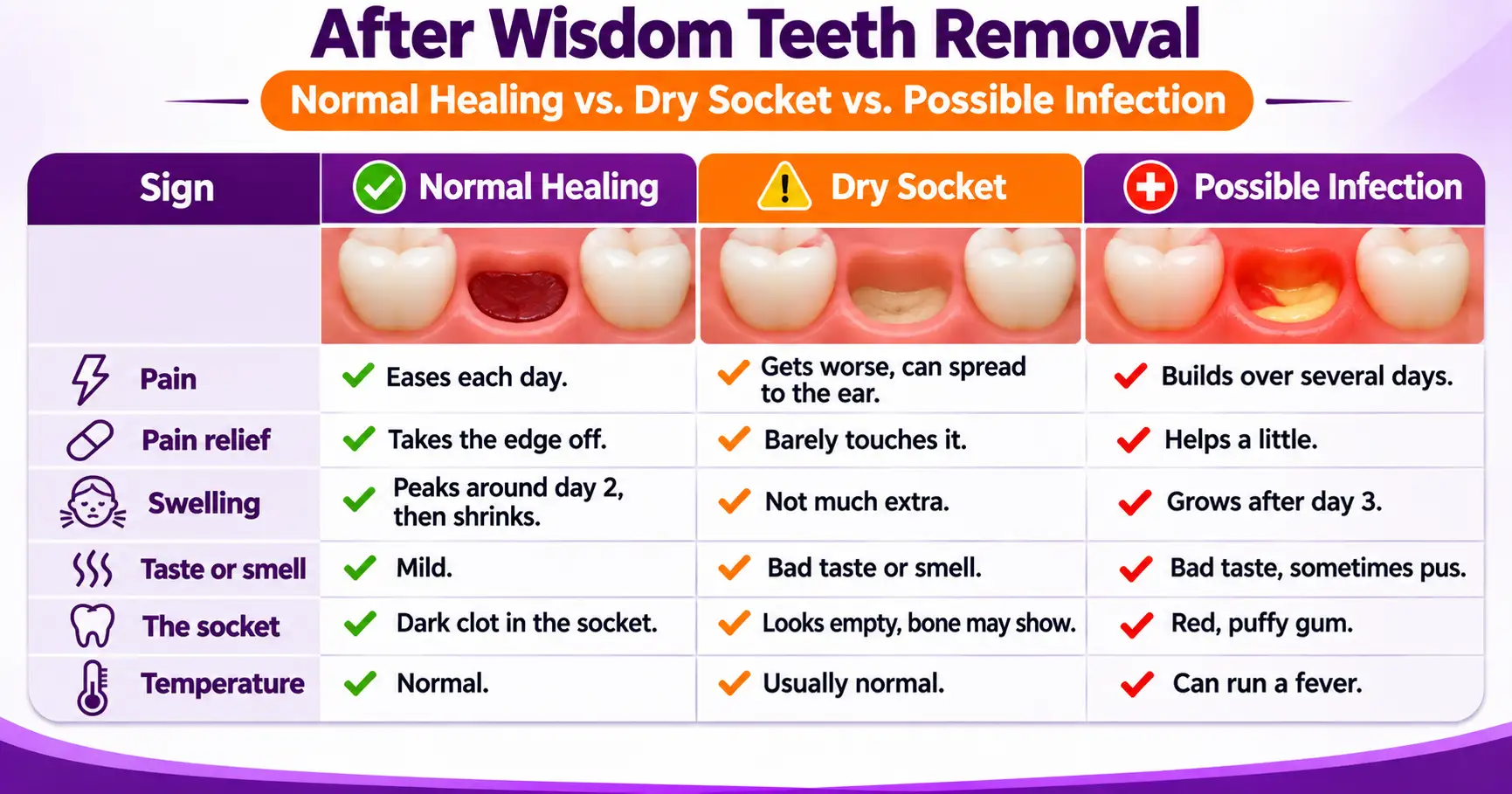
Here’s how the three usually compare.
| Sign | Normal Healing | Dry Socket | Possible Infection |
|---|---|---|---|
| Pain | Eases a little each day | Gets worse a few days after surgery, can spread towards the ear | Builds over several days |
| Pain relief | Takes the edge off | Barely touches it | Helps a little |
| Swelling | Peaks around day 2, then shrinks | Not much extra | Grows after day 3 |
| Taste or smell | Mild | Bad taste or smell from the socket | Bad taste, sometimes pus |
| The socket | Dark clot sitting in it | Looks empty, bone may show | Red, puffy gum |
| Temperature | Normal | Usually normal | Can run a fever |
Based on Better Health Channel, Healthdirect and SA Dental guidance, plus what we see in practice. Use it as a guide, not a diagnosis.
Does anything in those right-hand columns sound familiar? Ring us on (02) 9674 1964. Dry socket hurts, but it’s very treatable, and the sooner we see it the sooner it stops.
How Do I Know If I Have Dry Socket?
After a tooth comes out, a blood clot forms in the socket. Think of it as the body’s own bandage. Dry socket is what happens when that clot breaks down or falls out too early, leaving the bone and nerve endings underneath open to air and food.
The dry socket symptoms are hard to miss. A deep, throbbing pain turns up a few days after surgery, often just as things had started to feel better. A bad taste or smell usually comes with it. And when you look in the mirror, the socket looks empty.
It’s less common than people fear, and it’s very treatable. The Better Health Channel notes it happens more often in people who smoke or who heal slowly, so smoking is the big one you can control.
To look after that clot:
- No smoking or vaping for at least 48 hours, and longer if you can manage it
- No straws, and no spitting for the first few days. Lean over the sink and let the water fall out instead
- Wait a full 24 hours before your first salt water rinse, and keep it gentle
- Keep your tongue and fingers away from the socket, no matter how tempting
Should it happen, the fix is quick. We check and clean the socket, and usually place a soothing dressing in it. Many people feel relief soon after.
What to Eat After Wisdom Teeth Removal
Wisdom teeth sit right at the back, behind the teeth you normally chew with. Add a jaw that won’t open properly for a few days, plus lower sockets that act like little food traps, and you can see why the first week calls for soft, cool or lukewarm food you can swallow without much chewing.
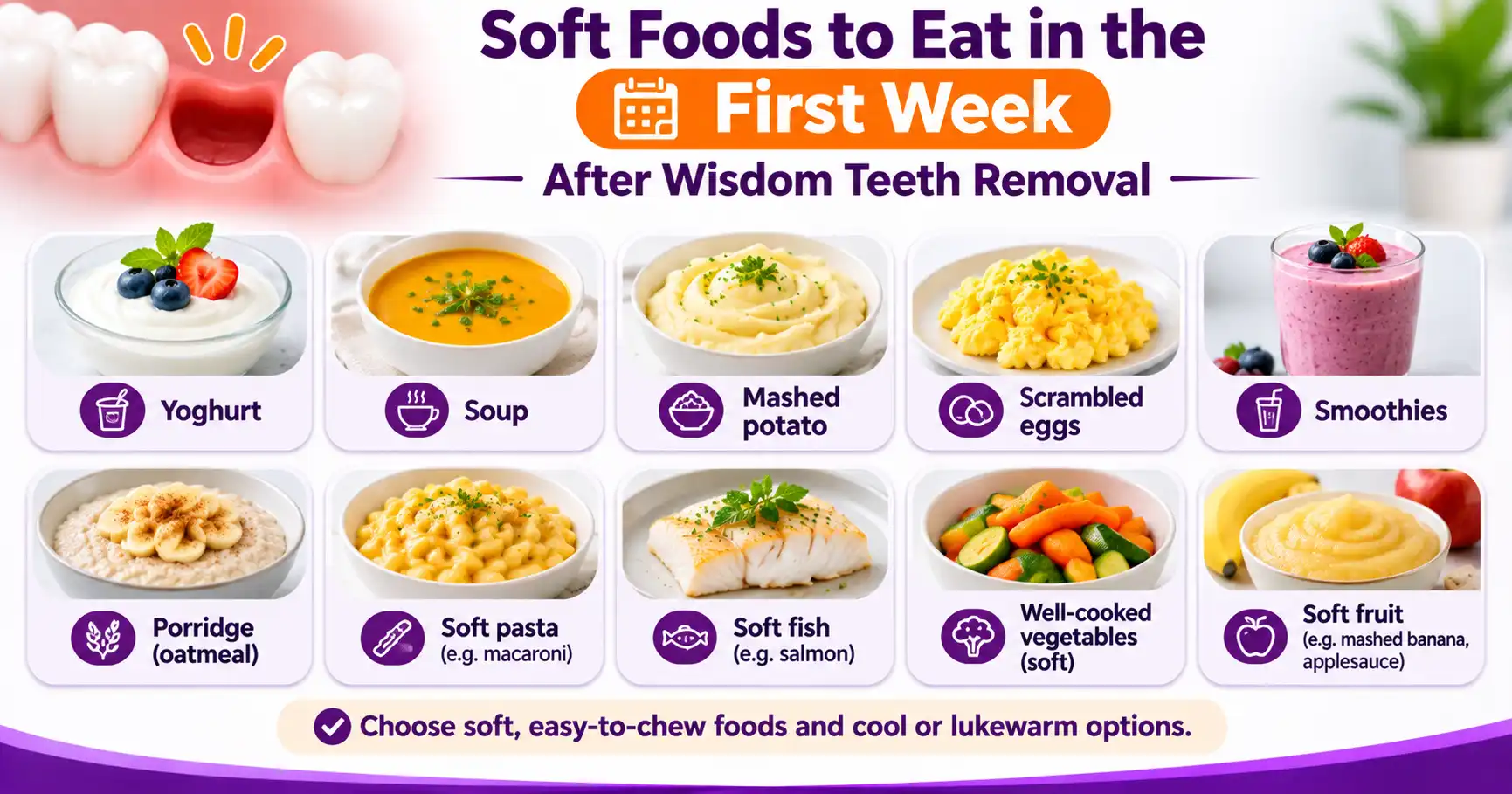
For the first day or two, think yoghurt, custard, mashed potato, apple puree, smoothies (eaten with a spoon, not a straw) and soup that’s been left to cool.
From about day 3, most people can manage scrambled eggs, soft pasta, flaked fish, porridge, ripe banana and well-cooked veg. Chew on the opposite side.
Give these a miss for the first week:
- Chips, nuts, seeds and popcorn, which lodge in the socket
- Rice and other small grains, for the same reason
- Crusty bread and anything chewy
- Chilli, very hot drinks and alcohol
The general rules that apply after any tooth comes out are on our what to do following an extraction page.
When Can I Eat Normally Again?
For most people, somewhere between one and two weeks. SA Dental says you can return to your normal diet over the week after surgery. Crunchy, hard and small foods come back last, since they’re the ones most likely to get stuck in a socket that hasn’t fully closed. A rough rule of thumb: once you can chew on that side without it hurting, and open your mouth all the way, you’re good to go.
How Much Time Off Work After Wisdom Teeth Removal?
Two things decide it: the kind of work you do, and how involved the removal was.
| Situation | Typical Time Off |
|---|---|
| Desk job, simple removal, local anaesthetic only | 1 to 2 days |
| Desk job, impacted or several teeth | 2 to 4 days |
| Physical work, lifting or sport | About a week |
| After IV sedation | At least the rest of the day. No driving until your dentist says the sedative has cleared. |
| After a general anaesthetic | At least the next day. No driving for 48 hours. |
Treat these as a guide, not a rule. They’re drawn from Healthdirect’s “up to a week” advice and what most people find in practice. The Australian Dental Association says a few days off may be needed depending on how difficult the removal is, that you shouldn’t drive for 48 hours after a general anaesthetic, and that sport and exercise should wait after any extraction.
A couple of practical tips. Book for a Thursday or Friday and the two hardest days land on the weekend. Need proof of sick leave for work? Ask us for a certificate on the day.
Is Recovery Easier With Sedation?
Not really. Sedation makes the procedure easier, not the healing. The socket heals the same way whichever option you choose.
Where sedation does help is the appointment itself, especially a longer or more complex removal, or for anyone whose stomach drops at the thought of the dentist. We offer two options in the surgery. Happy Gas (nitrous oxide and oxygen) helps you relax while you stay awake, and it leaves your system quickly enough that you can usually drive after about 15 minutes. IV sedation goes further: you can still respond, but you won’t be aware of the treatment, and the effects take a while to wear off. Our relaxation and sedation page covers both in more detail, and our guide to dental anxiety is worth a look too.
After IV sedation:
- Arrange an adult to take you home and stay with you for the rest of the day.
- No driving, alcohol or machinery until your dentist says the medicine has cleared.
- Leave anything important, like contracts or big decisions, until another day.
When Should I Call the Dentist After Removal?
Ring us on (02) 9674 1964 if you notice any of these:
- Bleeding that won’t stop, even after 30 minutes of firm pressure on gauze
- Pain that gets worse after day 3, or that pain relief doesn’t touch
- Swelling that’s still growing after day 3
- A bad taste, bad smell or pus coming from the socket
- A fever, or just feeling unwell
- Numbness in your lip, chin or tongue that’s still there the next day
That last one is worth a word. Numbness from the anaesthetic normally wears off within a few hours. When it doesn’t, the nerve may have been irritated during surgery. Healthdirect says this is usually temporary but can take up to 18 months to recover fully, so we’d rather check it early.
Urgent problems are covered on our emergency dental care page. Out of hours, Healthdirect is on 1800 022 222. For trouble breathing or swallowing, or swelling that spreads towards your eye or neck, call 000 straight away.
Frequently Asked Questions
Can I brush my teeth after wisdom teeth removal?
Yes. SA Dental recommends getting back to regular brushing as soon as possible. Brush the rest of your mouth from that night or the next morning, and steer clear of the socket on day one. After that, a soft brush and a light touch around the area is fine. A clean mouth lowers the risk of infection and dry socket.
When can I exercise after wisdom teeth removal?
Give it two or three days. A raised heart rate can get the socket bleeding again, and the Australian Dental Association advises avoiding sport and exercise after any extraction. A gentle walk is usually fine after that, but the gym and contact sport can wait about a week. Had a complex removal? Check with your dentist first.
Can I use a straw after wisdom teeth removal?
Not for the first few days. Sucking through a straw creates pressure in your mouth, and that pressure can pull the clot out of the socket. The Better Health Channel lists straws alongside spitting and heavy rinsing as things to avoid. Drink from a glass and eat smoothies with a spoon.
Do I need my stitches removed?
Usually not. Most dentists use dissolving stitches, which loosen and drop out by themselves within one to two weeks. We’ll tell you on the day if yours need taking out. A loose thread dangling in your mouth halfway through the week? Completely normal, and nothing to pull at.
Why is my jaw so stiff after wisdom teeth removal?
That’s trismus. The muscles near the surgery site swell and tighten, so your mouth won’t open as far as usual. It’s usually at its worst while swelling peaks and loosens as the swelling goes down over the week. Gentle opening and closing helps. Still getting stiffer after day 4? Come in and see us.
Book Your Follow-Up or Ask a Question
Questions about your recovery are always welcome, even if someone else took your wisdom teeth out. Kings Langleys Dental Surgery has looked after families from 7 Solander Rd, Kings Langley for more than 46 years. Call (02) 9674 1964, book online, or find out more about wisdom teeth treatment with us.