
Earlier than most parents expect. The Australian Society of Orthodontists recommends a first orthodontic assessment between ages 7 and 10, which catches a lot of families off guard. Braces at seven? No. A look at seven, so nobody’s guessing later.
That’s the short answer to “when should my child see an orthodontist”. Below: why that window, the signs worth acting on sooner, what the first visit involves, and what the Child Dental Benefits Schedule will and won’t pay for.
When Should My Child See an Orthodontist in Australia?
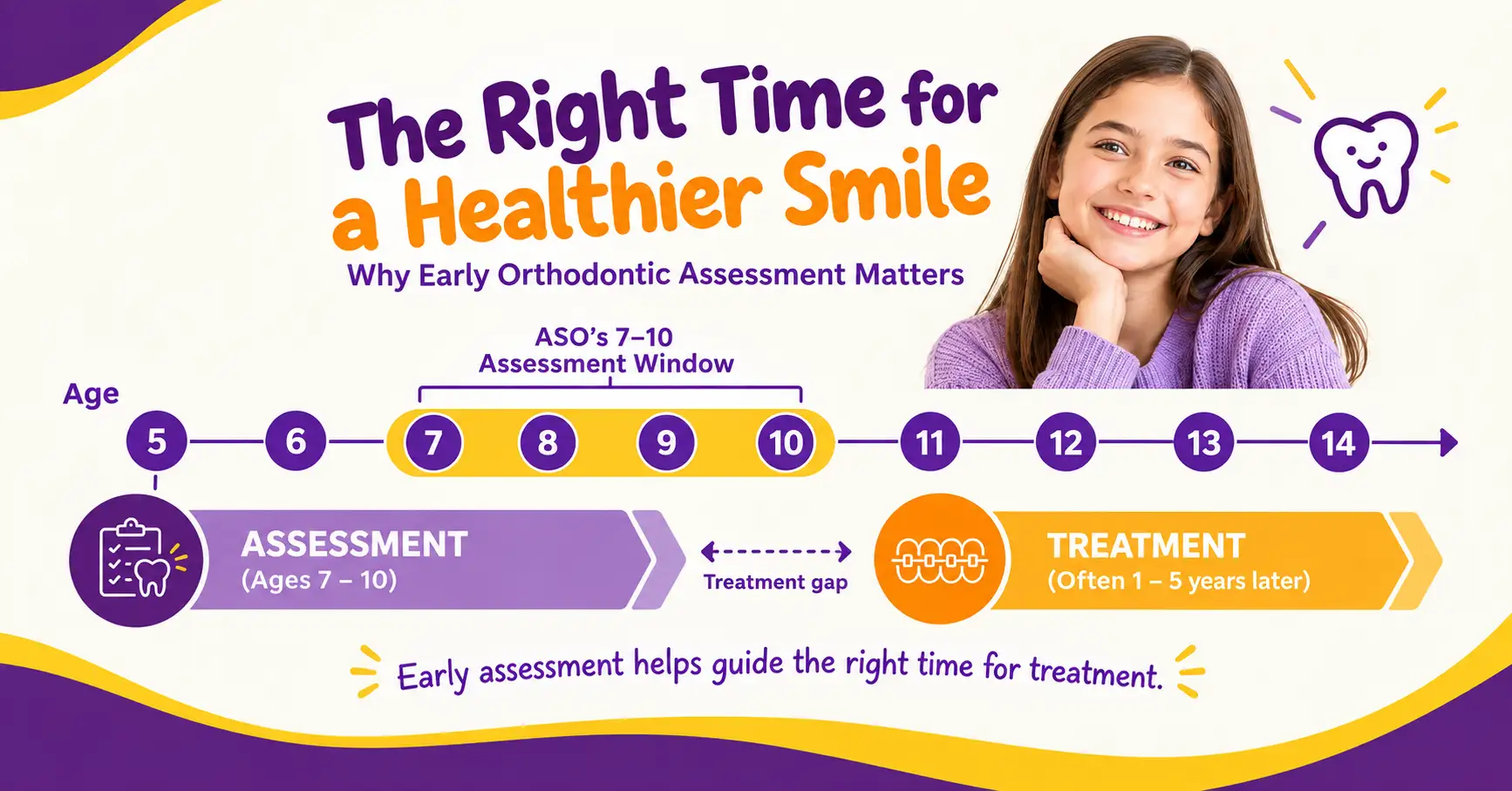
Between 7 and 10. That’s the window the Australian Society of Orthodontists (ASO) recommends for a first assessment, and it’s the one we work from at Kings Langleys Dental Surgery.
The timing isn’t random. By seven, the first adult molars and front teeth are usually through, so a child has a mix of baby and permanent teeth. That mix is what lets an orthodontist see how the bite and jaw are shaping up, including teeth that haven’t surfaced yet. Catch something here and there’s usually still room to guide it. Wait until the teens and you’re correcting rather than guiding.
One thing worth saying plainly: an assessment at seven does not mean braces at seven. Most kids who get an early look need nothing more than a review a year or so later.
Why Does Early Assessment Matter?
Because the jaw is still growing. The ASO notes that children’s jawbones stay relatively soft until the late teens, so where a child needs a correction, it often works faster and more simply while that growth is still happening.
Early screening also picks up problems that aren’t visible from the outside. A child’s front teeth can look perfectly straight while a crossbite or crowding is quietly developing behind them. And where treatment does turn out to be needed, the ASO says it often starts one to five years after that first assessment, not straight away. The early look sets the timing. It doesn’t force it.
What Are the Signs My Child Needs an Orthodontist?
Age is a guideline, not a rule. A handful of signs are worth a check before seven, whatever the calendar says. The ASO lists most of these, and we see them in the chair regularly:
- Losing baby teeth much earlier or later than expected, often through decay or a knock
- Thumb or finger sucking that’s still going past age five or so
- Mouth breathing or snoring at night, both of which can affect how the jaw grows
- Teeth that don’t meet properly when your child bites together
- Teeth that overlap, crowd, or stick out
- Trouble biting or chewing certain foods
- A jaw that clicks, shifts, or causes pain
- A family history of impacted or missing teeth
None of these mean your child needs braces. They’re reasons for a look, not a reason to panic.
What Happens at Your Child’s First Orthodontic Check?
At Kings Langleys Dental Surgery, that first visit is deliberately low-key. Our children’s dentistry team checks how the teeth and jaw line up, looks for early bite problems or crowding, and talks through anything you’ve noticed. A habit, a jaw that looks off, whatever’s on your mind.
Most kids walk out with nothing more than a six to twelve month review booked, just to keep an eye on growth. If something does stand out, a developing crossbite, a jaw pulling to one side, we’ll explain what a treatment plan would involve in plain English. Where a specialist orthodontist is the better call, we’ll say so and refer you on. No pressure either way.
Somewhere between seven and ten and haven’t had a look yet? Book it in. Kings Langleys Dental Surgery has cared for local families for more than 46 years, and our children’s dentistry is built to be gentle and fear-free, with Happy Gas on hand for nervous kids. Book an appointment and we’ll tell you where things stand.
Does CDBS Cover Orthodontic Treatment?
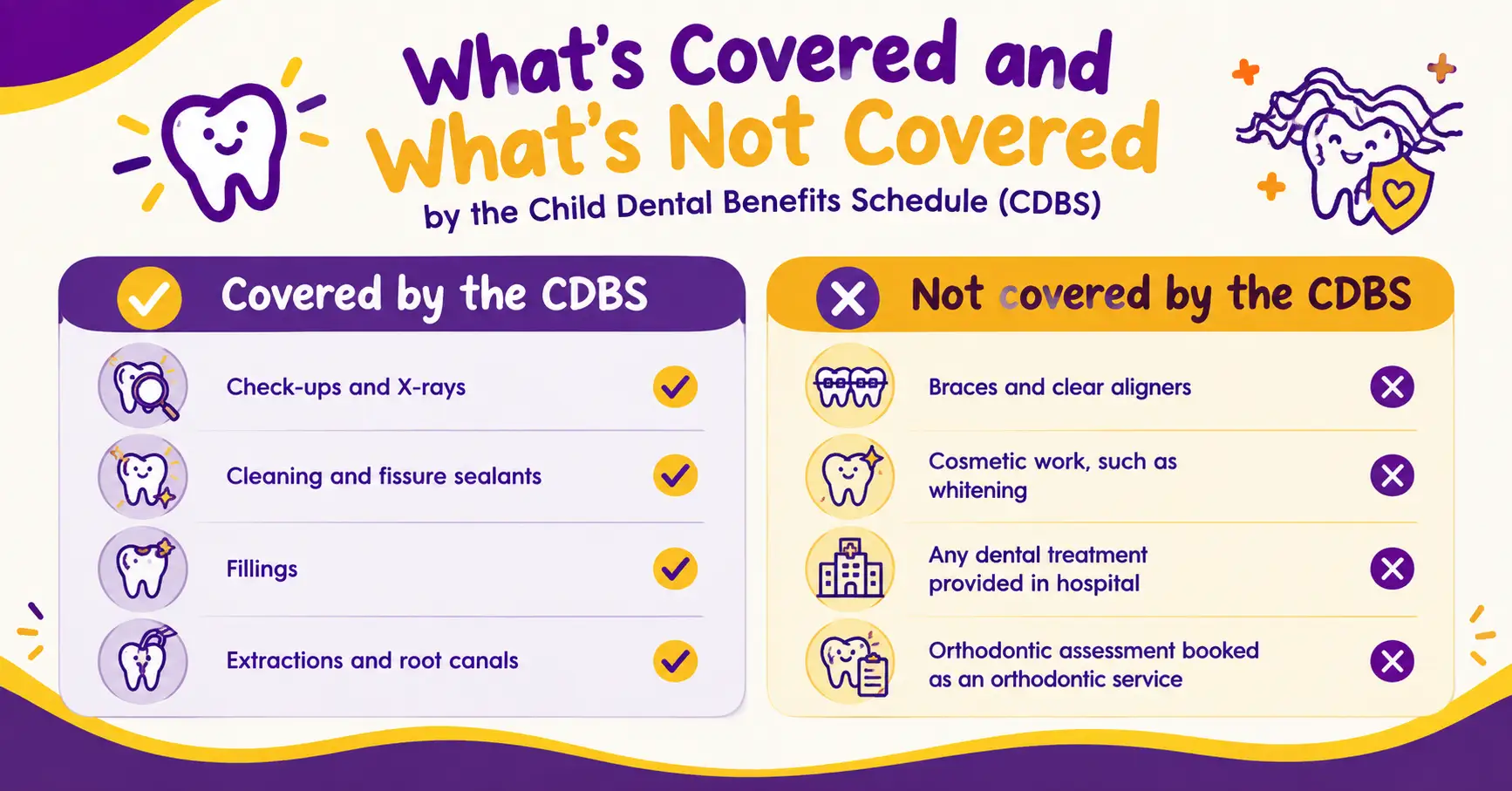
No. Braces and aligners sit outside the Child Dental Benefits Schedule entirely. Still worth knowing about, though. Services Australia confirms the CDBS currently covers up to $1,158 in basic dental care per eligible child over two calendar years, and it indexes the cap each January. For the full picture, see our Child Dental Benefit Schedule page.
| Covered by the CDBS | Not covered by the CDBS |
|---|---|
| Check-ups and X-rays | Braces and clear aligners |
| Cleaning and fissure sealants | Cosmetic work, such as whitening |
| Fillings | Any dental treatment provided in hospital |
| Extractions and root canals | Orthodontic assessment booked as an orthodontic service |
Families who qualify, usually through Family Tax Benefit Part A or a similar payment, should use it for the regular dental work regardless. Just budget separately for orthodontics, and ask about payment plans. Most clinics, including ours, offer them.
Early Assessment Doesn’t Mean Early Treatment
An assessment at eight doesn’t mean braces at eight. Most of the time it’s watch and wait, with a review every six to twelve months to track how things are growing. When early treatment does happen, it’s usually small: a space maintainer to hold a gap, a palate expander for a narrow arch, a simple appliance for a crossbite. Not a full set of braces.
The point is using the years while the jaw’s still growing. Ready to see what treatment looks like properly? Our orthodontics page covers what’s available.
Frequently Asked Questions
Do I need a referral to see an orthodontist in Australia?
No. You can book directly with a specialist orthodontist, no GP or dentist referral required. Most families see their dentist first anyway, since a general check-up is a natural place to raise concerns and get a steer on timing.
Is it ever too late for a first orthodontic check?
No. Seven to ten is the ideal window, but plenty of kids and teens start orthodontic care later and still get great results. Older and not assessed yet? Book one rather than waiting for a milestone age.
What’s the difference between an orthodontic assessment and starting treatment?
An assessment is a look. Most kids assessed early don’t start treatment straight away. Your dentist monitors them with periodic reviews until either things settle on their own or the timing’s right for a proper treatment plan, often one to five years later.
Does private health insurance cover children’s orthodontics?
It can, depending on your policy’s extras cover and its orthodontic waiting periods, which tend to run longer than general dental. Check your policy directly, since coverage and annual limits vary a lot between funds.
Can jaw problems cause pain or headaches in children?
Yes. A jaw that isn’t sitting right can click, ache, and in some cases trigger headaches, especially alongside teeth grinding. Mention it at your child’s next visit if you’ve noticed either. More on our jaw problems and headaches page.
To Sum Up
Seven to ten. That’s the window, and it’s a look, not a commitment. Most children who get checked early need nothing but a follow-up, and the few who do need something are far easier to help while the jaw is still growing. Our team can assess your child, explain what we see in plain English, and refer to a specialist orthodontist if that’s the right next step.
Book an appointment today, or read more about our children’s dentistry first.